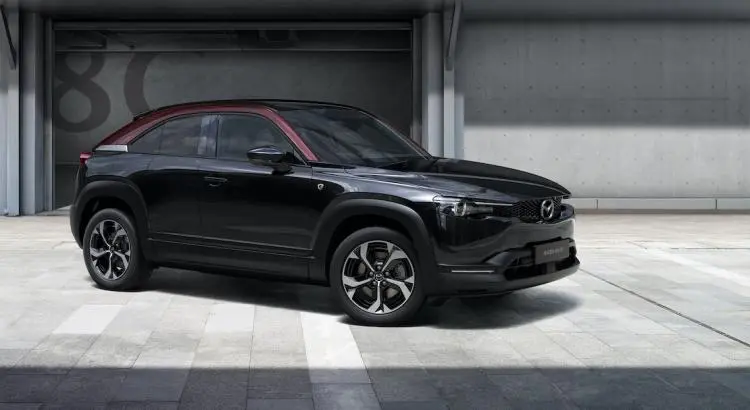


Mazda MX30 R-EV: its rotary engine is a good idea?, Mazda MX-30 e-Skyactiv R-EV: a rechargeable hybrid version to correct its biggest defect

Mazda MX-30 e-Skyactiv R-EV: a rechargeable hybrid version to correct its biggest defect
Special series “Edition R” “Width =” 750 “Height =” 410 ”/>
Mazda MX30 R-EV: Its rotary engine is a good idea for a rechargeable hybrid ?
There are several ways to see the electric car. The first, and by far the simplest, is to recharge the battery with an outdoor power source. This is the very principle of electricity as we know it. But the manufacturers quickly imagined another more philosophical solution with the autonomy extension. This system is characterized by the presence of a heat engine which acts as an energy generator and feeds the battery in real time. In all cases (except hackers as was the case with the Opel Ampera), the heat engine is not connected to the wheels and only the electric machine advances the car. However, the name of this technology can be misleading. Because even if the car is advancing electricity solely, it is no longer an electric vehicle in the eyes of the administration and changes in the hybrid segment. Which is perfectly consistent with the real technical name of this technology, known as hybrid-series.
Most of the time, a modest mechanics is used to generate electricity. This must be as economical as possible, inevitably, and its level of power does not really matter for the driver since the engine does not entail the wheels. The BMW i3 Rex embarked a 650 cc from the Kymco scooter manufacturer. The E-Power note, the first to use this technology at Nissan, was based on a 3 cylinder 1.2 l atmospheric. Far from the new Turbo engine with variable compression rate (KR15 code) of the Nissan Qashqai and X-Trail e-Power, and which occupies the place under the hood because of its technologies.
From now on, this exotic branch in the hybrid vehicle segment has a new member: the Mazda MX-30 R-EV. The opportunity for the Hiroshima firm to reconnect with the old knowledge that is the famous rotary engine. Compact, simple, powerful and devoid of vibrations, it has everything of the ideal thermal generator on paper. The fact remains that if it technically seduces, it does not seem to revolutionize the system, which has already experienced some attempts like the Audi A1 e-tron of 2010 for example, also with a rotary engine.
A new 8C rotary for the Mazda MX-30 R-EV
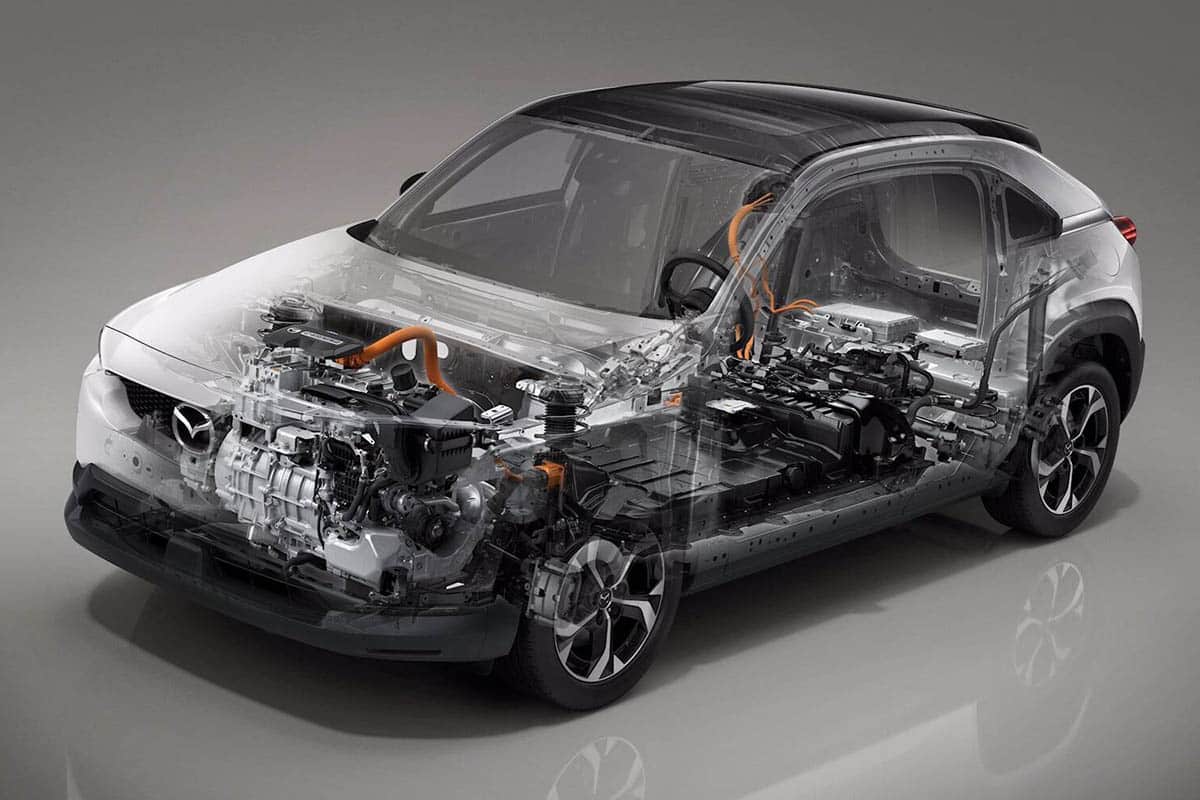
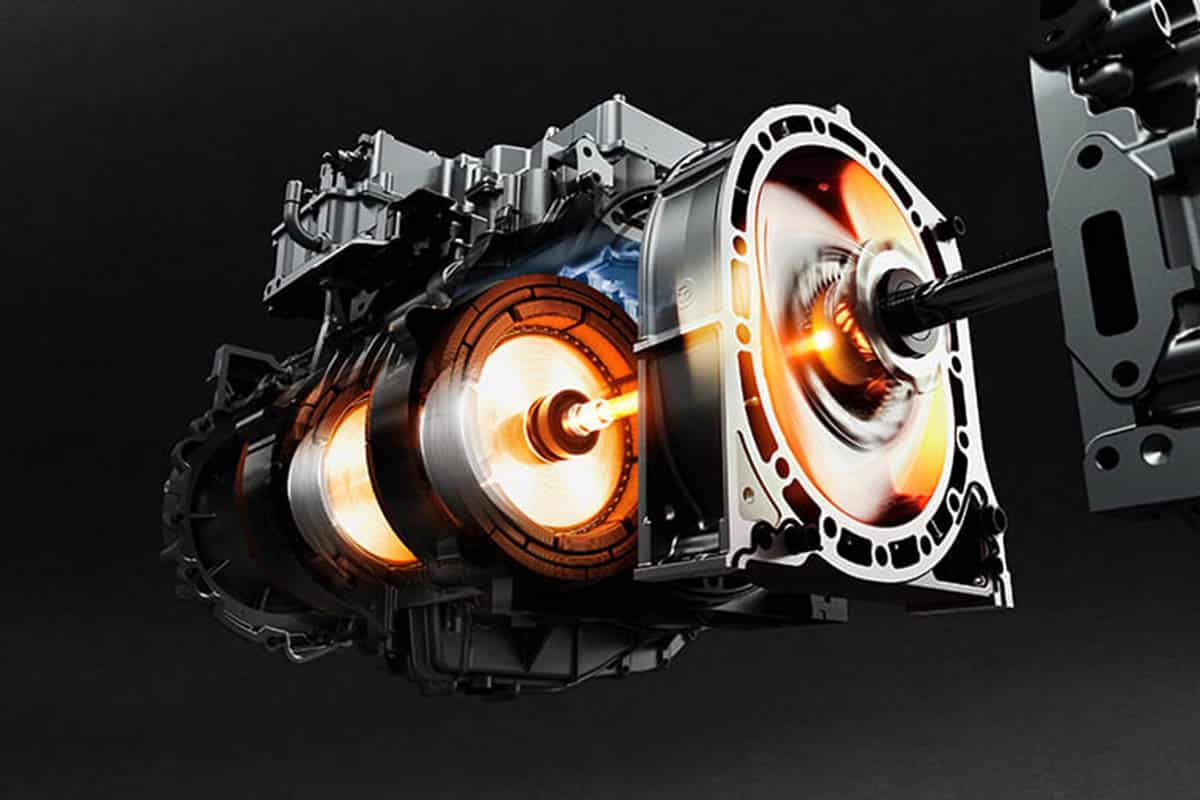
The operation is in the main lines: the heat engine causes a generator that produces the current to recharge the battery, the latter thus supplying the electrical machine connected mechanically to the front wheels. The heat engine is therefore the part of the system that interests us today. Responding to the code name 8C, it is a mono rotor of an 830 cm3 displacement that has been completely redesigned. The rotor has a radius of 120 mm and a thickness of 76 mm. The segments display a thickness of 2.5 mm to improve their longevity and general reliability. Still at the construction level, the aluminum block allows the engine to claim 15 kg less compared to the Birotor Renesis of the Mazda RX-8.
Like all rotary, this engine is very compact and therefore does not take up much space under the hood of the MX-30. It was thus attached to the generator and the electric machine to form a single block 84 cm wide. What save from the place under the hood of the SUV according to the manufacturer. But it is good to remember that the engine bay has not really imposed a very large technical challenge: the MX-30 is also available in Japan with a Skyactiv-G heat engine much more imposing.
The manufacturer specifies that the walls of the rooms have been the subject of a plasma surface treatment to reduce internal friction. To this is added a direct injection (a first for a serial rotary) and a gas recirculation system to improve efficiency, control consumption and reduce emissions. Finally, the compression rate of 11.9: 1 is a little higher than on common engines (efficiency is privileged at the expense of power), but does not reach the ratio of the e-Power system (until ‘at 14: 1) for example.
With 74 hp at 4,700 rpm for 116 Nm of torque at 4,000 rpm, the heat engine displays modest values. As usual with this rotary piston engine, the torque does not panic the counters. But it should be available earlier than with a traditional engine. This should be sufficient for the missions requested, especially since this block also has the advantage of presenting better yield and more optimal rotation diets. Depending on the manufacturer, it can turn between 2,450 and 4,500 rpm. A desire to create a better correlation between the engine speed and the rhythm of driving.

A CX-60 PHEV battery
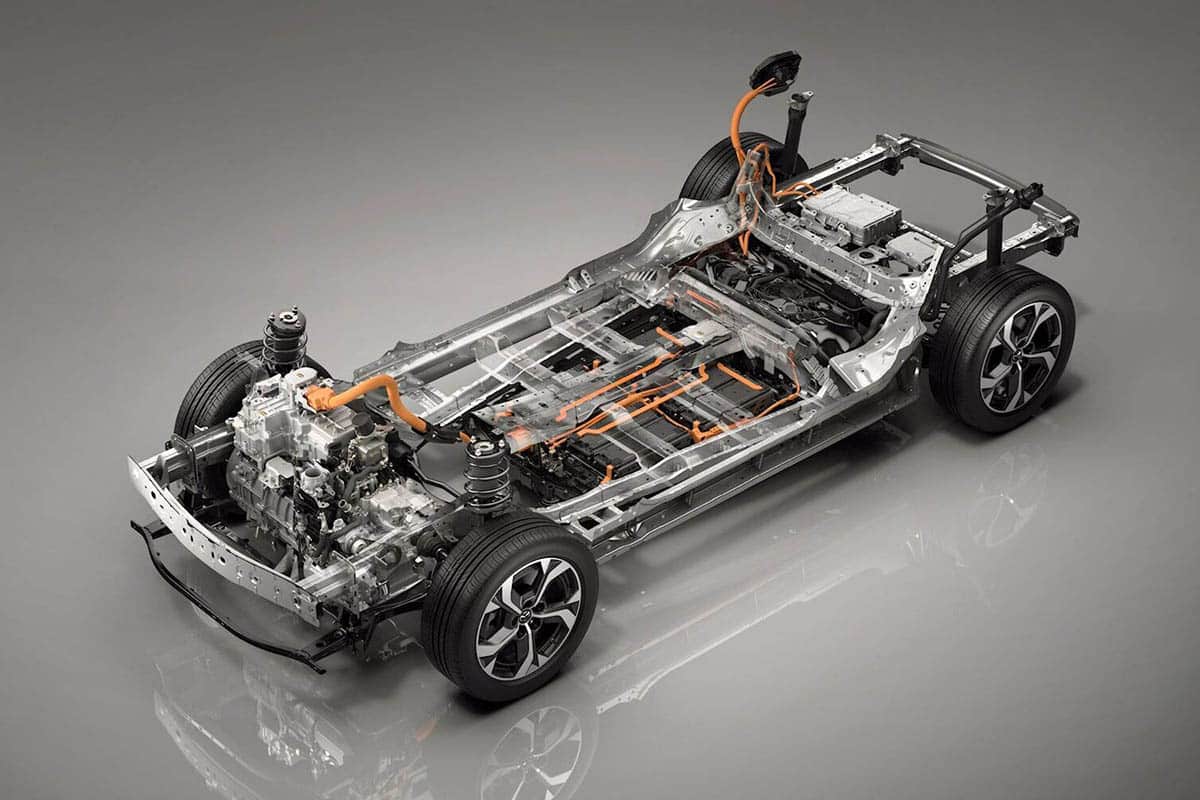
As you can see, this engine therefore has a generator role in powering the traction battery. This goes from 35.5 kWh to the 100 % electric version at 17.8 kWh. A unit much more generous than that of 1.9 kWh used by the e-power system. Above all, that of Mazda is rechargeable by alternating current (11 kW) or in direct current (35 kW). Enough to fill up in almost 50 or 25 minutes respectively. Mazda did not specify the exact origin of the battery, but it is not the unit of the MX-30 EV scalpated of a few cells. Its dimensions had to be reviewed to make room for the 50 -liter tank. It could probably be a reogenced version of the Mazda CX-60 PHEV battery: the total capacity of 17.8 kWh and the voltage of 355 V are strictly identical. Which means that the total capacity of cells is 50 Ah.
This battery, of which we do not know the output power, then feeds an electric machine with a maximum power 170 hp (125 kW) for 260 nm of torque. By being in direct contact on the front wheels, it is its values which appear on the technical sheet. However, this does not mean that the battery can power the machine with full power. There is surely a ditch that the rotary engine will have to fill. This will be the case in normal driving mode, where it will take over automatically. According to power demand, it can directly supply the electric machine via the generator. In EV mode performance should be lower. Finally, in recharge mode, the 8C block will take care of recharging the battery. A nonsense in a rechargeable hybrid vehicle, all the more equipped with a fast load system.
Consumption that promises to be very high
All this therefore has only one goal: to offer even more autonomy to the Mazda MX-30 (which is sorely lacking in an electric version) while best controlling consumption. On the pure electric autonomy side, Mazda announces a mixed value of 85 km. By combining the two energy sources, the SUV claims 600 km of autonomy in total. We do not yet have the detail of the hybrid operation, but it clearly appears that the electrical and thermal autonomies have been added. A quick calculation without scratching your head too much indicates a consumption of 9.7 l/100 km. Or 8.3 l/100 if we stupidly take all the autonomy in account. In short, consumption should oscillate in these waters. But surely more with a battery on its available load base !
This is what to expect using the SUV in normal mode. However, let us recall that consumption would spour be fictitiously lower with management of the battery load. As with the ex-PSA system, it is possible to reach very attractive consumption values, but only for a few kilometers. Beyond, the battery is empty and the driver rolls with the worst scenarios. And those who already imagine that it will always be possible to refuel fast should especially think if they should not choose an electricity ..
Only the frequency of electrical developments will then lower the average with this PHEV, as usual. In any event, to reach the WLTP value of 1.0 l/100 km (21 g/km of CO2), it will be necessary to drive nearly 90 % of the time in electric mode according to our calculations. In other words: it will be necessary to browse 900 km over 1,000 km alone in the power of the electric machine … We will not emit hasty conclusions since all uses are in nature, but the ratio appears difficult to achieve in reality.
Finally, the most precise will remember that if the CO2 and NOX emission levels are similar to those of a conventional heat engine, unraveled hydrocarbons (HC) are much more important. However, studies claim that in the case of a hybrid-series application like here, the HC would not be “Not so high”. A vague conclusion for data that is difficult to verify in without very specific measurement tools.
The ideal generator on paper, a little less for use
The Mazda MX-30 R-EV is therefore no longer an electric vehicle as the brochure would like to pass. It is nothing more or less than a rechargeable hybrid SUV with an exotic traction chain where only the electric machine drives the wheels. This is however one of the advantages of hybrid-series architecture: the instantaneity of the machine gives driving pleasure similar to that of an electric. It remains to be made to forget the presence of the heat engine as best as possible. And that’s what the rotary engine wants to do. Naturally free from vibrations, compact and light, it then has the shape of the generator perfect for this application. And these characteristics there, he has them.
But they struggle to show real benefits in absolute terms. Its dimensions do not really benefit from habitability (it does not give off a storage space under the hood) and its controlled weight, a guarantee of better autonomy on paper, seems to have no effect: with a total of 1,780 kg, the SUV is heavier 130 kg compared to the 100 % electric model, and 320 kg compared to the Japanese thermal version ! Wanting to save weight with mechanical technology is to be emphasized. But it must not be the tree hiding the forest. Too bad, because with a total mass of 71 kg, it is lighter than the KR15 Nissan and its 125 kg on the scale.
For him, he only has the lack of vibrations. But Hiroshima engineers have already shown that the too complex thermal engine of the E-Power system based on specific silentblocs can also effectively remove vibrations in the structure. It will therefore be necessary to put it to the test of the road to take stock of its real consumption which, according to our theoretical projections, promise to be much higher than those of the competition. In addition, customer use will make it possible to take stock of the technical advances of this rotary piston engine, sadly deemed in the past for the longevity of the joints of the rotor and for its consumption of congenital oil, which should have been the subject a separate line in the technical sheets as it has proven to be important.
Recall that the Mazda MX-30 R-EV is displayed from € 38,250 in the Prime Line finish. The special edition R Edition R climbs at 45,450 €. The Kia Niro Phev, its direct competitor, displays a grid of € 39,140 to € 43,940, with much more reasonable consumption when it comes to making long journeys on board.
Mazda MX-30 e-Skyactiv R-EV: a rechargeable hybrid version to correct its biggest defect
Launched in 2020 as the first 100% electric Mazda model, the MX-30 adopts a new variant, this time rechargeable hybrid thanks to a rotary engine used as a generator of generator.
Zapping Auto Moto Renault Rafale: First contact with the large pave of diamond